

The sequence begins with a pose so familiar we rarely question what it asks us to see.
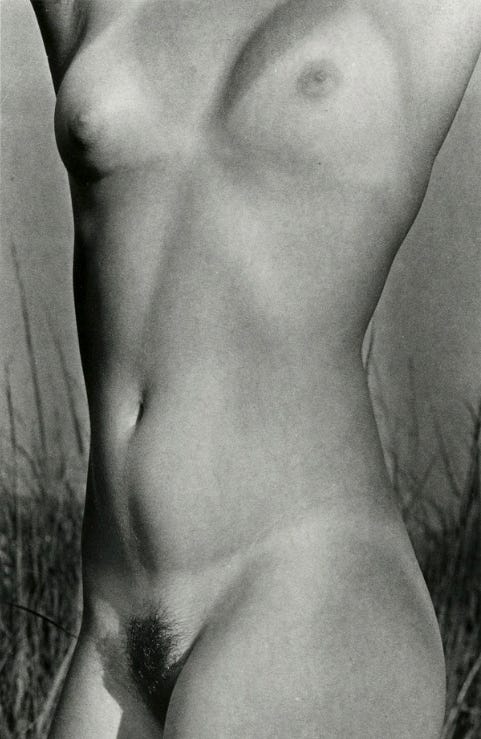
Arms raised, torso elongated, the chest lifted into the light. In the history of the female nude, this gesture is almost cliché. We’ve learned to read it as openness, vulnerability, even surrender. It exposes the breasts, softens the posture, and invites the gaze to linger. For more than a century, photographers have relied on this pose to signal availability to the viewer, particularly within the logic of the male gaze.
What is the male gaze, you might ask. Simply put, it is a way of seeing that focuses on the body, most often the female body, as an object. Heads, and especially faces, are hidden to prevent connection with a person. Arms and hands, those instruments of human action and agency, often disappear. When I think of the other meaning of arms, as weapons used to defend or destroy, I wonder what other messages—or fears—might be on display. I’ve also come to question whether the phrase “female form,” so commonly used to describe presentations of the female nude, serves as a way of sidestepping the presence of a person with desire, power, and vulnerability.
When I first encountered this image by Ralph Gibson, I wasn’t thinking about subversion or theory. I was responding to its formal clarity: the sculptural line of the torso, the way the raised arms activate and expose the body’s architecture.
Recreating the pose with a male body raised a different set of questions.
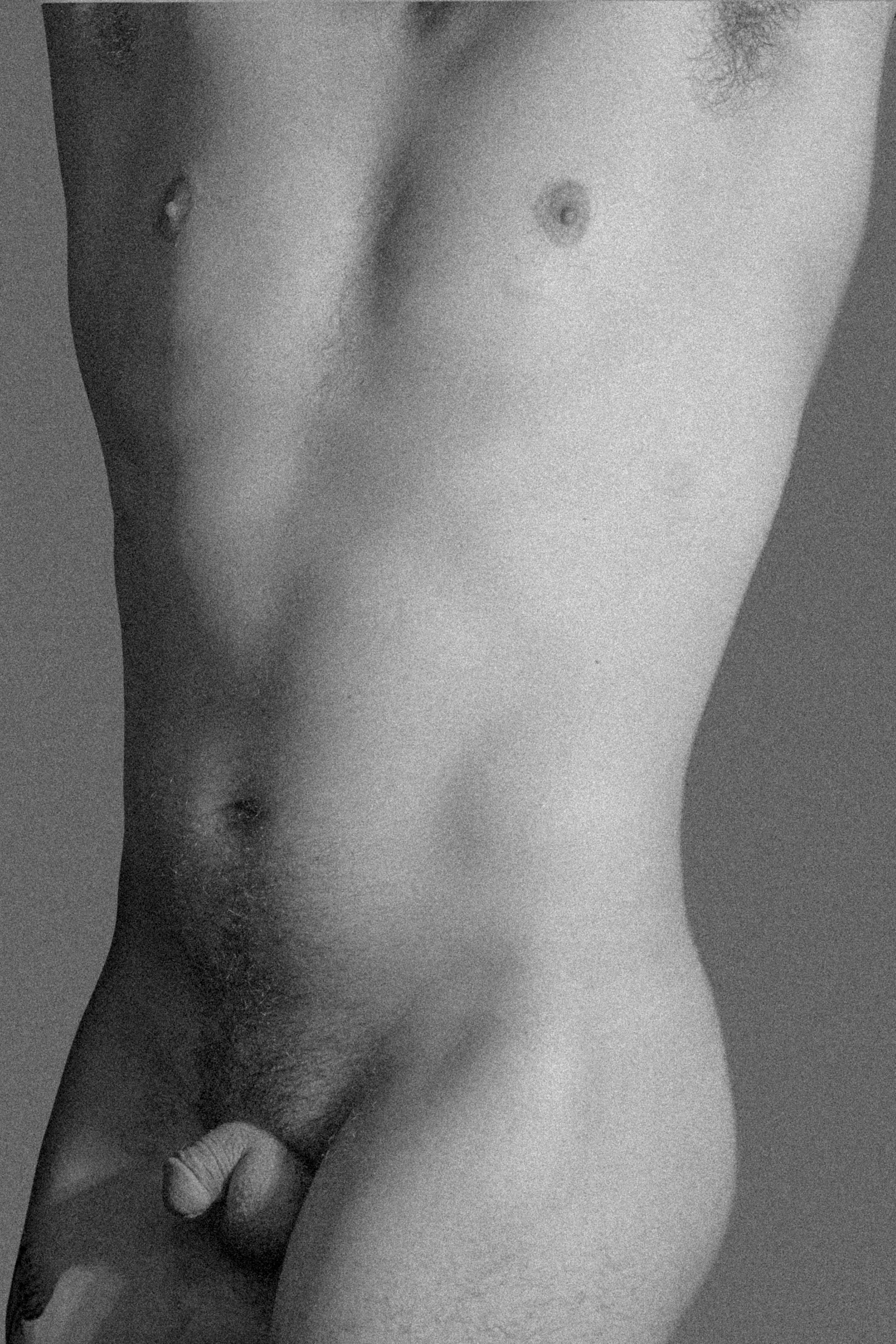
The arms lift in the same way. The torso elongates. But the reading shifts. Does the gesture still suggest surrender? Or does it register as something else: assertion, display, vulnerability, or perhaps ambiguity? We have not been culturally conditioned to read the male body as available in quite the same way. When availability does appear in the male form, it is often met with suspicion or discomfort rather than invitation.
I was less interested in answering that question than in letting it remain ambiguous, and in allowing something more whole to emerge.
The composite that follows was one of the earliest moments when the project began to move beyond equivalence. Rather than placing the images side by side, I layered them, allowing forms to merge, contours to soften, and identity to become less fixed. As I worked with texture and color, the image took on an unexpected quality. It felt less photographic and more archaeological, as if it might have been a fragment lifted from the wall of a Roman villa in Pompeii.
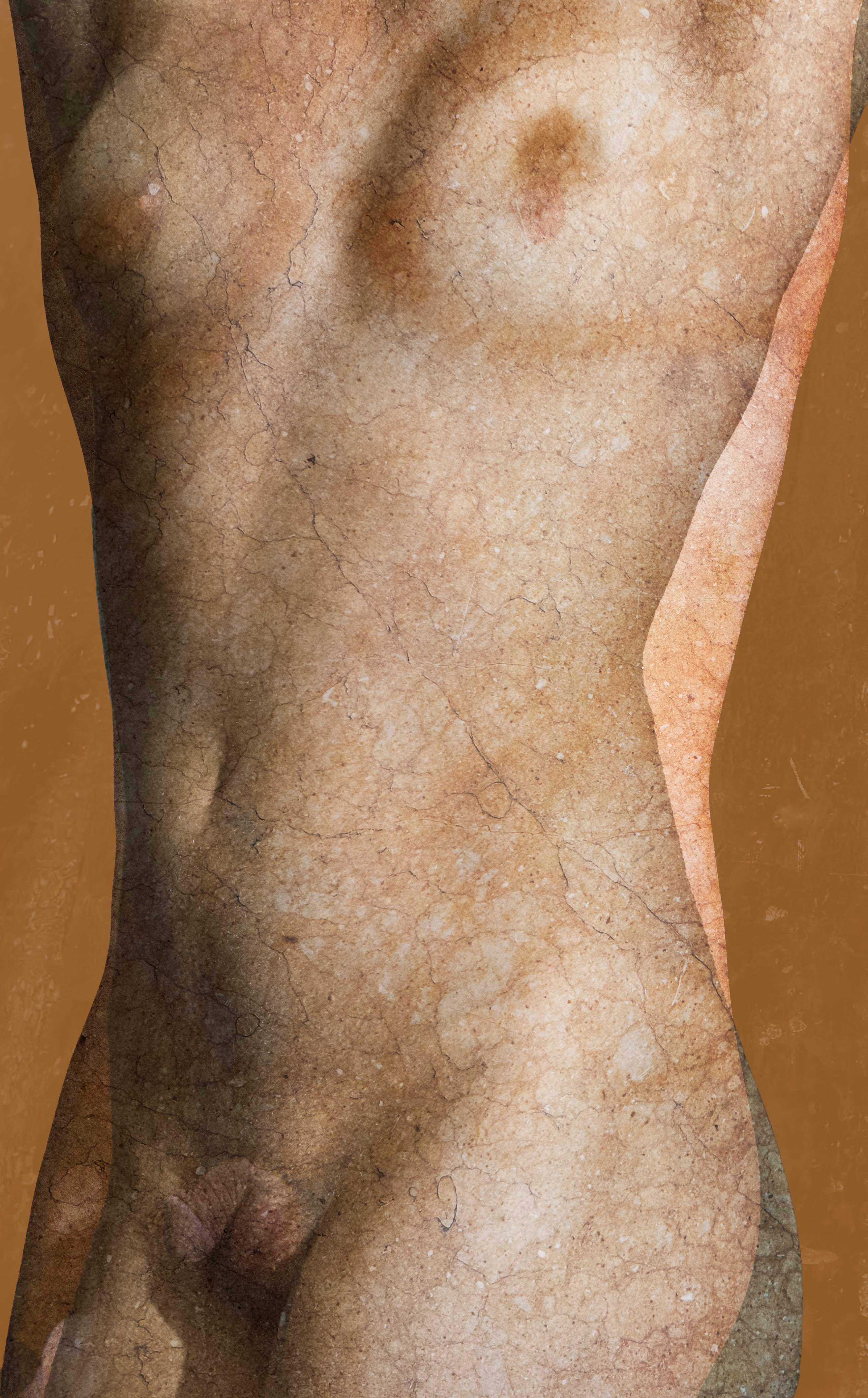
That sensation excited me.
Frescoes were not portraits in the modern sense. They were symbols, gestures, embodiments of ideals and myths. Seen through that lens, the composite no longer belonged exclusively to either gender. It existed in a liminal space, neither male nor female but carrying traces of both.
The question of androgyny is hardly new. Across cultures and centuries, bodies that resist clear categorization have been revered, feared, mythologized, erased, or celebrated. What interested me at this point was not the historical cataloging of those responses, but the visual experience of uncertainty itself: the moment when the eye searches for a category and the mind fails to find one.
This image marks the point where Fe/Male began to loosen its original premise. What started as a dialogue between two bodies evolved into something more fluid. I began exploring how binaries might be visualized as mutable by not insisting on them.
I think of this composite now as a threshold image. It doesn’t announce its intentions loudly. Instead, it invites a slower looking, one that allows contradictions to coexist and meanings to remain provisional.
In the posts that follow, I’ll share others like it, along with stories of their development and reflections on how the work and my thinking continued to evolve once I allowed ambiguity to lead.
If you’d like to see the broader arc of the work, including related images and ongoing projects, you can visit my photography website here:
www.nicholaskingphotography.com
What do you notice first when familiar poses are inhabited by unfamiliar bodies? And how comfortable are you letting an image remain unresolved?