
Seeing Beyond the Surface
The Art and Evolution of Between Binary Illusions

Welcome to My Photographic Eye. I’ve spent many years working with the human form, following a thread of curiosity about beauty, identity, and the stories our bodies carry. This first post shares the evolution of a project that reshaped how I see—not only others, but myself.
This ongoing body of work, definitely my most distinctive, is but one thread of my practice. My publication also includes Landscapes, Portraits, and Experiments. Posts in them will follow soon.
In The Beginning: Fe/Male
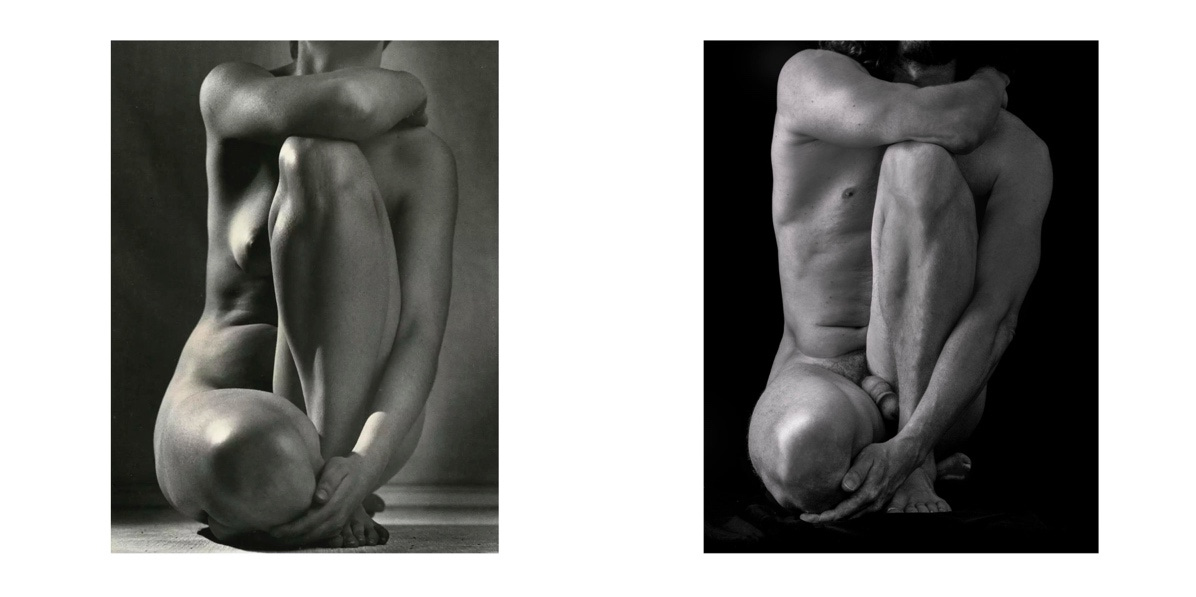
We are each born into a body, but not into a single form.
From the beginning, this project was, and continues to be, an inquiry that is visual, cultural, philosophical, and deeply personal. What began as a photographic exploration of gendered perception, “the gaze,” evolved into a layered practice. I now ask more foundational questions about how we see the human form, how we’re seen, and who decides what counts as beautiful, natural, or whole.
My first experiments were with what I called the Fe/Male series: pairing 20th-century photographic nudes of women with contemporary images I made of male models in nearly identical poses and lighting. Initially, I was simply inverting visual expectations from “the gaze,” as with the Ruth Bernhard image above. I was exposing assumptions about gender and beauty and about the way cultural conditioning shapes our emotional and intellectual responses to bodies.
Does a nude man posed reclining, or otherwise inactive, feel vulnerable, erotic, unsettling, or feminine?
Why is the female form readily accepted, even when eroticized, while the male nude remains fraught or rare in fine art?
These pairings revealed not only physical contrast but cultural dissonance and rigidity.
And yet, that was only the beginning. I soon discovered that contrast, as a conceptual method, was too limited. What I was moving toward was not inversion but integration.
From Inversion to Integration
As the Fe/Male project progressed, I became increasingly aware of how deeply entrenched binary thinking was in our aesthetics, our expectations, and even our gazes. But rather than merely swapping roles or reversing positions, I began to ask:
What would it mean to dissolve and blend the binary visually?
Could I create images in which masculine and feminine coexist not in tension, but in harmony?
This marked the beginning of a new series of composite photographic nudes that blended male and female bodies into unified forms. These composites contain multiplicity, not as contradiction but as completeness.
I started calling the project Beyond the Binary, believing I was moving past the cultural constructs that shape how we perceive gender, beauty, embodiment, and theology.
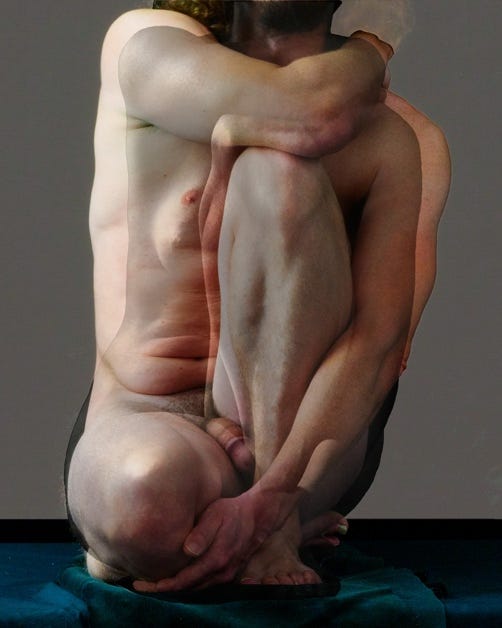
For many months, that phrase worked.
But recently I began questioning the accuracy of that title.
“Beyond” implies outside, even otherness, as if the body, or biology, or cultural history could be stepped past or left behind. And while my composites do invite a kind of re-seeing that loosens the binary’s grip, they remain rooted in material presence. They do not reject embodiment; they integrate it.
Research revealed the binary poles themselves as illusions, biologically, emotionally, and culturally.
I wondered if “masculine” and “feminine” are not immutable truths, but visual and verbal myths handed down by history, aesthetics, and religion.
This line of inquiry led to a new title:
Between Binary Illusions.
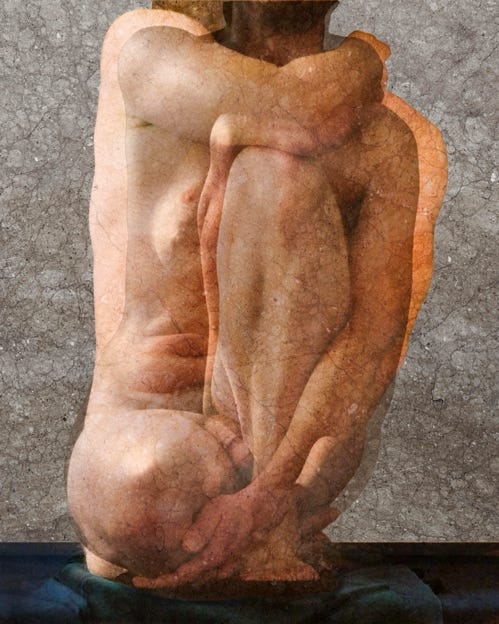
This phrase better reflects where the work now resides.
The images do not simply depict a rejection of form, nor do they transcend gender. They evoke a timeless aspect of the human condition from pre-history to distant futures.
They suggest a presence between myths: between the culturally imagined poles of male and female, strength and softness, dominance and vulnerability.
Maybe, considering the galactic or otherworldly qualities some images suggest, they offer a visualization aligned with Ursula Le Guin’s sense of what life might be in other realms, formed differently, imagined differently.
The work is not beyond the binary; it exists between its idealized logic, revealing how constructed, permeable, and contradictory those categories have always been.
What the Images Now Ask
In this light, the composite figures become meditations on the emotional, cultural, biological, and theological spectrums that shape what it means to be human. They ask the viewer:
to live with ambiguity,
to inhabit a space where categories dissolve,
to see both/and rather than either/or.
In Le Guin’s fictional world of Gethen, fixed gender does not exist, this way of seeing is natural. We may not be Gethens, but the longing for such integration of self, of perception, of possibility, is no fiction.
So this is the story of a project’s evolution: from Fe/Male, to Beyond the Binary, to Between Binary Illusions.
The photographs have always been visual inquiries. Only now do I see more clearly what they have been asking—and what they have been revealing.
In upcoming posts, I’ll share the stories behind individual images, how certain composites emerged, and the thinking behind them.
Closing
Thank you for reading this first piece. In the coming weeks, I’ll share the early Fe/Male pairings, the composites that followed, and the layered process behind them. Each post will reflect the same spirit that guides the work itself—curiosity, presence, and an openness to what images can reveal.
This publication also includes Landscapes, Portraits, and Experiments. The work you see here is one distinctive thread of my practice; the others will follow soon.
If you’d like to explore more of my work, you can visit my photography website at NicholasKingPhotography.com.